
An Iran peace deal doesn't mean cheaper fares. That's great news for airline stocks.
TSA
- Oil prices have fallen to about $70 a barrel amid a US-Iran peace deal, but fares likely won't drop.
- Analysts say carriers are seeing favorable supply-and-demand dynamics, partly driven by the war.
- US airline stocks are rallying as investors expect lower oil prices to boost profitability.
Flyers hoping for cheaper flights this summer may be disappointed.
Oil prices — airlines' second-largest expense after labor — have tumbled to nearly $70 a barrel from highs above $100 after the US and Iran announced a preliminary agreement to end the nearly four-month war that closed the Strait of Hormuz, a vital artery for global oil shipments.
Aviation analysts say airlines won't rush to cut ticket prices or their lucrative checked-bag fees even if the war between the US and Iran ends. Israel is also not a direct party to the agreement.
Since the US and Israel launched the conflict in late February, carriers have cut unprofitable routes and raised fares and ancillary fees to offset higher fuel costs.
Richard Aboulafia, aviation analyst and the managing director of AeroDynamic Advisory, told Business Insider that tight seat supply, combined with resilient demand, has given airlines little incentive to reverse course on pricing.
"Things are pretty good, maybe traffic is down a little, but profits aren't, right?" he said. "So why would you? Inflation is a great excuse to get more pricing power."
US airline stocks are rallying as investors expect the favorable mix of lower fuel costs and sustainable high fares to boost profitability.
Data from KAYAK flight search shows that average domestic airfares are up about 8% since the war started; average international airfares are up about 18%. Fares from the US to Amsterdam and London, for example, have increased by more than $200 roundtrip.
US airlines have also raised checked bag fees by as much as $50 one-way to offset soaring oil prices, with most major carriers now charging between $40 and $50 per bag each way.
Airline CEOs at Delta, United, and Southwest aren't disputing analysts' warnings, saying resilient demand, tight capacity, and durable pricing power are reasons fares are likely to remain elevated even if oil prices ease further.
"We and our competitors are all focused on ratable production of results, steady production of results, sustainable margins, and so I do think that produces a backdrop where we'll certainly not attempt to give some of these fare increases back," Southwest CEO Bob Jordan said at the Bernstein Strategic Decisions Conference in May.
Don't expect flight prices to drop
Raymond James analyst Savanthi Syth told Business Insider that for airline ticket prices to fall, supply needs to increase or demand needs to soften — but she said that's unlikely, especially since oil is still up 50% year-over-year and oil shocks may continue even with a deal.
"Capacity through August is likely mostly finalized by now, so the opportunity to gain confidence to add back more capacity (or get back to the prior plan) would be in 4Q at the earliest," she said, referring to the fourth quarter that begins in October.
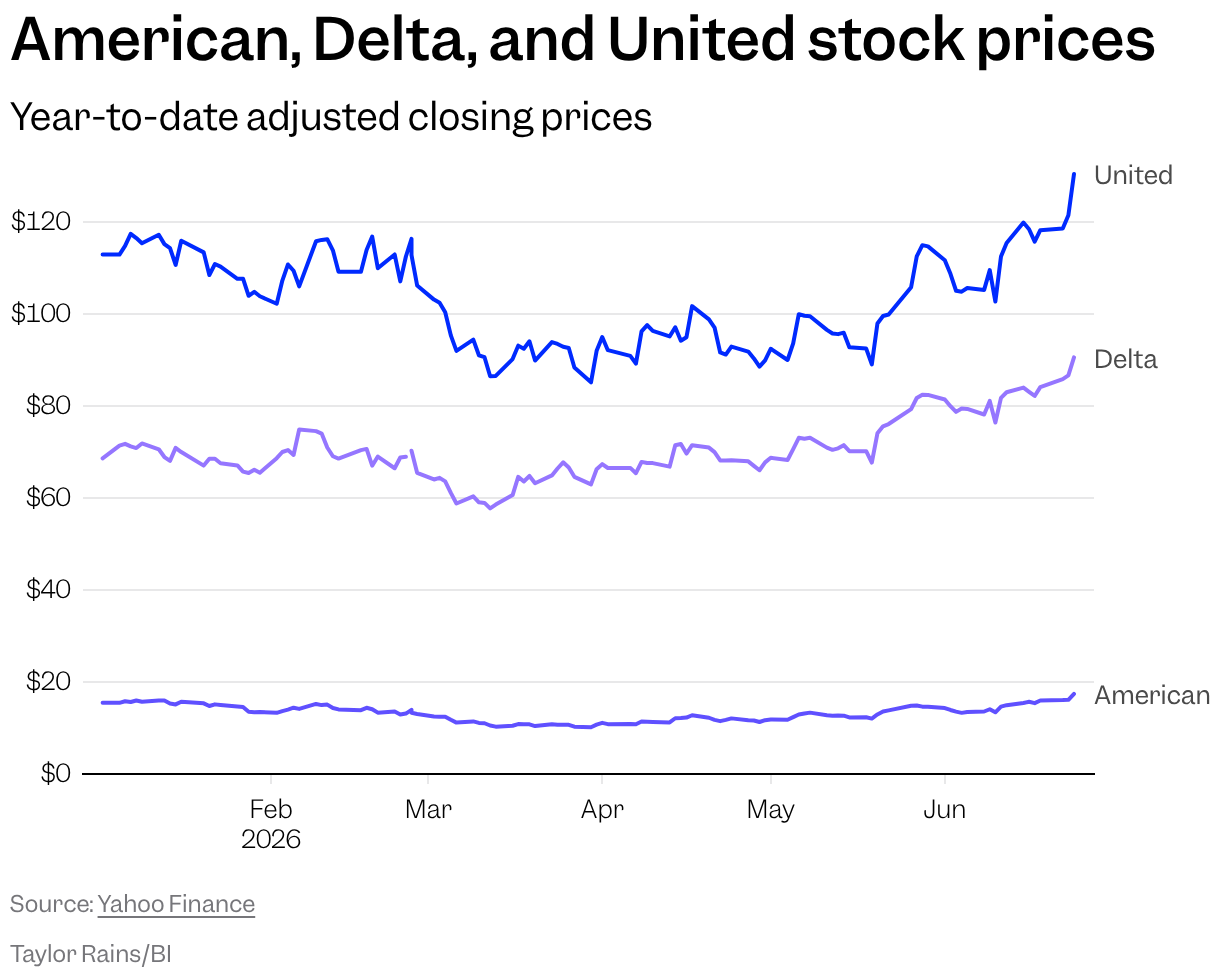
US airline stocks have surged in recent days as oil prices fall and investors anticipate wider profit margins. Delta Air Lines' stock has risen above $90 since Wednesday, surpassing its pre-war high of about $75 in early February.
United Airlines' stock is trading at about $134 on Thursday, up from roughly $117 before the conflict. The carrier has outperformed its legacy rivals on Wall Street in recent years as it adds new aircraft, expands premium cabins, and grows its international network.
American Airlines has also gained ground, though its stock remains well behind its larger rivals at about $17 a share as of Thursday. The carrier has historically trailed Delta and United in profitability.
These rallies could quickly fade if tensions in the Middle East escalate again and the Strait shuts back down.
The Trump administration has repeatedly announced possible deals to end the war, but many ultimately fell through. The latest agreement, signed last week, extends the ceasefire for 60 days as the sides negotiate on the thorniest issues, including the whereabouts of Iran's highly enriched uranium. Win McNamee/Getty Images
Officials have spoken about the deal in broad statements, but its specific terms remain secret. On Tuesday, President Donald Trump warned that if Iran were to acquire a nuclear weapon, "all hell will rain down on them."
Time will tell how durable the US-Iran agreement proves to be, and some airlines may be hedging their bets. United CEO Scott Kirby told Bloomberg at an industry conference in early June that he is not confident any deal to reopen the Strait of Hormuz would last.
Syth said that airlines in general may also be hesitant to add capacity after a series of shocks over the past two years, including persistent inflation that has driven up operating costs and two government shutdowns that caused mass flight delays and cancellations.
NerdWallet travel analyst Sally French told Business Insider that the pricing picture also has to factor in Spirit Airlines' collapse in May and the loss of its cheaper tickets.
"With fewer seats and one fewer ultra-low-cost carrier, we're generally not seeing the kind of downward pressure on fares that budget-conscious travelers want," she said.
As for checked bag fees, all three analysts say they are unlikely to drop. Data from the Bureau of Transportation Statistics shows US airlines made roughly $5.5 billion in revenue from checked bag fees in 2025.
"Changes there tend to be stickier regardless of the demand environment," Syth said, adding that it should be a while before bag fees increase further if oil prices are lower.
Editor's note: This article was originally published on Monday and has been updated.
What's Your Reaction?
 Like
0
Like
0
 Dislike
0
Dislike
0
 Love
0
Love
0
 Funny
0
Funny
0
 Angry
0
Angry
0
 Sad
0
Sad
0
 Wow
0
Wow
0


